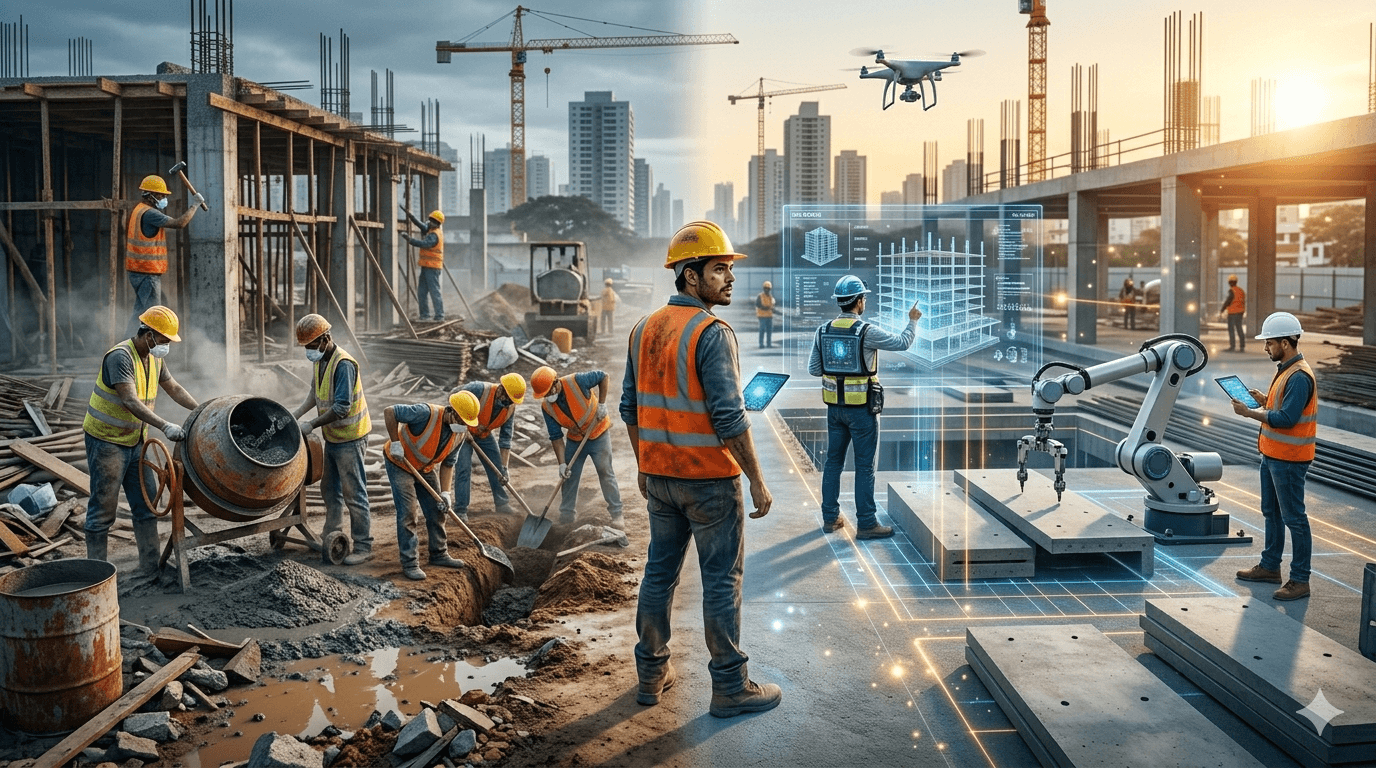
This change is not just technological.
👉 It is a mindset shift.
And companies that understand this first will have a significant competitive advantage in the coming years.
Below are 7 technologies that are already transforming civil construction in Brazil — but that are still little explored by most of the market.
🧠 1. BIM: the foundation of smart construction
BIM (Building Information Modeling) is much more than a 3D model.
It is an integrated system that allows creating, managing, and updating construction information throughout its entire life cycle — from design to operation.
In practice, BIM allows:
-
identifying clashes between disciplines before execution
-
improving planning and predictability
-
reducing rework
-
increasing productivity
-
lowering costs and risks
👉 The great differential of BIM is turning design into reliable information.
⏱️ 2. BIM 4D: when time enters the project
BIM 4D adds the time dimension to the digital model.
This means the project stops being purely static and starts to be simulated over time.
With this, it is possible to:
-
visualize the progress of the work step by step
-
anticipate scheduling conflicts
-
better plan the use of equipment and teams
-
reduce delays
This approach also allows organizing production by location, improving site control and efficiency.
📡 3. IoT: sensors that transform construction sites into data
The Internet of Things (IoT) allows capturing information directly from construction sites in real time.
Sensors can be used to:
-
monitor material movement
-
track physical progress
-
record execution times
-
identify operational bottlenecks
👉 The result is a more transparent and controllable construction.
Instead of relying exclusively on manual records, operations start generating data automatically.
☁️ 4. Cloud computing: real-time integration
The cloud allows all construction information to be available in real time to different teams.
This reduces the distance between:
-
site and office
-
engineering and management
-
execution and planning
With centralized data, it becomes possible to:
-
make faster decisions
-
reduce communication failures
-
improve quality and productivity control
🔗 5. Blockchain: traceability and trust
Blockchain is gaining ground in civil construction due to its ability to securely, transparently, and immutably record information.
In practice, this allows:
-
tracking materials and components
-
recording deliveries and completed stages
-
creating a reliable history of operations
👉 This reduces conflicts, increases transparency, and strengthens trust among all involved.
🧪 Case study: traceability of prefabricated components
In projects using industrialized elements like facades or frames, each component can be identified and tracked from manufacturing to installation.
With combined use of sensors, digital systems, and blockchain, it is possible to record:
-
departure from the factory
-
arrival at the site
-
internal movement
-
installation
-
final validation
Each step is securely and auditable recorded.
👉 The result is greater control, fewer conflicts, and more efficiency.
🤖 6. Smart contracts: contracts that execute automatically
Smart contracts are digital contracts that execute actions automatically based on pre-defined conditions.
In civil construction, they can be applied to:
-
release payments upon completion of stages
-
automatically validate deliveries
-
control execution milestones
🧪 Case study: payment release by stage
Imagine a contract structured as follows:
-
part of the payment at factory dispatch
-
part upon delivery at the site
-
part after installation
-
part after final validation
With integrated data (BIM, sensors, and digital records), these steps can be automatically verified.
👉 This reduces bureaucracy, avoids conflicts, and speeds up financial flow.
🧬 7. Digital Twin and Artificial Intelligence: the future of construction management
The Digital Twin concept represents an evolution of BIM.
It is a digital model continuously connected to the construction reality.
When combined with Artificial Intelligence, it enables:
-
predicting delays
-
identifying failure patterns
-
suggesting operational improvements
-
anticipating problems before they happen
👉 The project stops being reactive and becomes predictive.
⚠️ Why do few companies still use these technologies?
Despite clear benefits, adoption is still limited by factors such as:
-
traditional operational culture
-
lack of integration among departments
-
technical unfamiliarity
-
implementation difficulties
-
absence of data governance
👉 The biggest challenge is not technology — it is the transformation of management.
🚀 What changes for those who adopt these technologies
Companies moving in this direction quickly notice:
-
reduction of rework
-
increased productivity
-
greater deadline predictability
-
better cost control
-
more transparency in processes
-
greater competitiveness
🧠 Conclusion: the future of construction will be data-driven
Civil construction is entering a new era.
An era in which:
-
decisions will not be based on assumptions
-
processes will not rely solely on manual control
-
information will be the main asset of the project
The presented technologies are not distant trends.
👉 They already exist.
The difference lies in who decides to use them strategically.
🔎 Final reflection
If your construction site were completely data-driven today...
👉 how many errors could be avoided?
📚 Sources and references
-
Guideline: Use of I4.0 Technologies and BIM in Construction Management — Construa Brasil Program (MDIC)
-
Guidelines on digitization, BIM, and innovation in the AECO sector
-
Studies on the integration of IoT, cloud computing, and blockchain in civil construction
-
Management, control, and digital transformation practices applied to the sector